The Personal Touch: Why Handwritten Scripts Like Anthoni Signature Endure
In a world of standardized fonts and digital uniformity, the quest for authenticity in design has never been stronger. This desire for a unique, human touch drives the enduring appeal of handwritten signature scripts. Among these, a style known as Anthoni Signature represents a particular class of digital handwriting—one that captures a natural, stylish flow, offering designers a tool to imbue projects with personality and sincerity.
Beyond the Digital Uniform
Consider the visual landscape we navigate daily. From interfaces to advertisements, a majority of text is rendered in clean, geometric, or professionally kerned typefaces. These fonts are engineered for clarity, scalability, and brand consistency. They are essential. However, they often lack the emotional resonance that a handwritten mark provides. This is where signature scripts fill a critical gap. They introduce an element of the individual, the crafted, the personally authored.
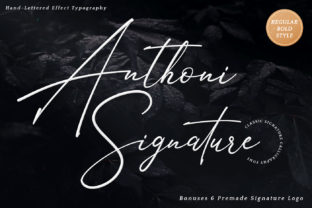
The characteristics of a well-executed script like Anthoni Signature are distinct. It typically features variable stroke weights, where the thickness of the line changes naturally, mimicking the pressure of a pen on paper. The connections between letters, or ligatures, are not mechanical but organic, creating a sense of continuous motion. There is often intentional irregularity—a letter might be slightly taller, a curve a bit more pronounced—which avoids the robotic perfection of a standard font. This calculated imperfection is the source of its authenticity.
The Anatomy of Authentic Flow
What separates a generic script font from one with a signature-quality flow? Several technical and artistic considerations come into play.
- Baseline Rhythm: Unlike fonts where every character sits rigidly on a line, signature scripts allow characters to dance slightly above and below the baseline. This creates a natural, undulating rhythm.
- Contextual Alternates: Advanced scripts include multiple versions of the same letter. The letter "o" that follows a "w" might be different from the "o" that follows an "l," ensuring connections look fluid and unforced.
- Natural Swashes and Exit Strokes: The beginning and end of words often feature elegant extensions or tapered finishes, replicating the way a hand naturally moves into and out of a word.
These features, embodied in designs such as Anthoni Signature, are not merely decorative. They are engineered responses to the question: how can digital type feel genuinely handwritten?
Practical Applications in the Real World
The utility of a signature script extends far beyond simply mimicking a signed name. Its real-world relevance is found in its ability to elevate design across numerous fields by adding a layer of human connection.
For business owners and professionals, it can transform branding materials. A logo for a boutique bakery, a personal brand for a consultant, or a header for a craft brewery might incorporate such a script to communicate craftsmanship, attention to detail, and a personal stake in the product. It signals that there is a person, not just a corporation, behind the work.
Creators and hobbyists, such as digital artists, stationery designers, or wedding planners, use these fonts to create invitations, quotes, artwork, and social media graphics that feel bespoke. A standard font on a wedding invite can feel mass-produced; a well-chosen signature script instantly feels curated and thoughtful.
In the realm of education and research, educators creating engaging presentation materials or researchers designing posters for conferences might use a handwritten element to highlight key takeaways or titles, making the information feel more accessible and personally communicated.
Considerations for Effective Use
While the advantages are clear, successfully implementing a signature script requires mindful application. The primary consideration is legibility. Due to their stylized nature, these fonts are best used for headlines, logos, short quotes, or emphasized phrases, not for long body text. Overuse can make a design feel cluttered and difficult to read.
Another key point is tonal matching. The specific style of the script must align with the overall message. A script with a very elegant, formal flow might suit a luxury brand but feel out of place for a children's toy company. The "natural stylish flow" of Anthoni Signature, for example, suggests a balance of sophistication and approachability, fitting a wide range of contemporary design ideas.
Finally, it’s crucial to remember that these are tools to augment authenticity, not replace it. They work best within a design that already has genuine substance. Using a signature script on a poorly designed website or a low-quality product won’t magically instill trust; it might even highlight the disconnect.
The Workflow Integration
Integrating a handwritten script into a modern digital workflow is straightforward. Once a font like Anthoni Signature is installed, it becomes available in any standard design software—from Adobe Creative Suite to Canva to PowerPoint. The designer’s task is then compositional.
A common workflow involves setting the primary headline or focal point with the signature script to establish the personal tone. Complementary elements are then built using simpler, more legible sans-serif or serif fonts. This creates a visual hierarchy where the handwritten element draws attention and emotion, while the supporting text provides clear information. Spacing around the script is also important; giving it ample room allows its unique forms to breathe and be appreciated.
Observing Trends and Evolution
The use of handwriting in design is not static. Current trends show a movement towards even more realistic scripts that incorporate subtle textures, paper-like backgrounds, or even variable digital "inking" effects to deepen the illusion of physical creation. There is also a counter-trend towards hybrid designs, where a signature script is blended with very modern, minimalist layouts, creating a striking contrast between the humanistic text and the clean digital environment.
This evolution speaks to a broader cultural observation: as our interactions become more digitally mediated, the value we place on signals of humanity within that digital space increases. A handwritten script is one of the most direct visual signals available.
Advantages Beyond Aesthetics
The benefits of employing a signature script extend past making something simply "look nice." On a psychological level, text that appears handwritten can foster greater engagement and trust. Readers may subconsciously perceive it as more direct and personal, as if the message was crafted specifically for them. This can be particularly powerful in marketing, educational materials, or any communication aiming to build a relationship.
From a brand differentiation standpoint, in a market where many competitors might use similar standard fonts, a distinctive signature element can become a memorable part of a brand’s visual identity. It helps a business or creator stand out by showcasing a willingness to invest in unique, tailored design elements.
For the individual designer or content creator, access to high-quality signature scripts expands their toolkit. It provides a ready-made solution for achieving a handwritten aesthetic without requiring the skill of custom calligraphy for every project, balancing efficiency with artistic impact.
The key is to view scripts like Anthoni Signature not as mere fonts, but as bridges. They bridge the gap between the efficiency and reach of digital design and the emotional depth of human craftsmanship. They allow an authentic touch to be scaled, shared, and integrated into the vast and varied canvas of our digital world, reminding us that even in pixels, there is room for a personal hand.